A 3rd-person platformer
Role: Level Designer
Building a full level set in Morocco that serves as the game’s 3rd level. Going from concepting setting, level structure and story, though blocking out platforming beats to polishing and iterating on the layout as well as overseeing setdressing.

Team: 25

5 months

UE 5
Project Role:
Level Designer

Sand Slide
Whitebox in UE5
Sketching and research
Collab with artists
Testing and Iteration
Design documentation
City Platforming
Main Responsibility: Create Morocco Lvl 1
I was given the task to create a game level set in a Morocco-like environment from concepting to polish. This level ended up as the game’s Demo Level also featured in the closed playtest, which meant it needed to be clear and digestible as a first level for players as well - but in the final game the level takes place around the middle of the whole experience.
Below are some of the main characteristics that give the level its identity:
Vehicle sections

Pizzapocalypse 2 is the successor to a previous student project made by some people in the current team. In this new expanded experience you play as a pizza chef in a world where Pizza Corp, a giant corporation selling pizza-in-a-can drove traditional pizza chefs completely out of business.
You use your pizza for expressive platforming movement as well as to combat the robots of Pizza Corp, traversing a number of countries on your quest including Italy, Morocco and Greece.
Gameplay Trailer
About Pizzapocalypse 2

Research and Concepting
To create a Morocco-like immersive environment that is also used for expressive and fun platforming in an urban setting the research included:


Analyzing Moroccan urban architecture to create a recognizable shape language
Creating a unique identity for the level featuring level elements and mechanics that fit in the setting and separate the level from the others
Concepting level structure, striving for a visually and mechanically memorable spaces and platforming challenges
Unique elements research
Urban environment sketches
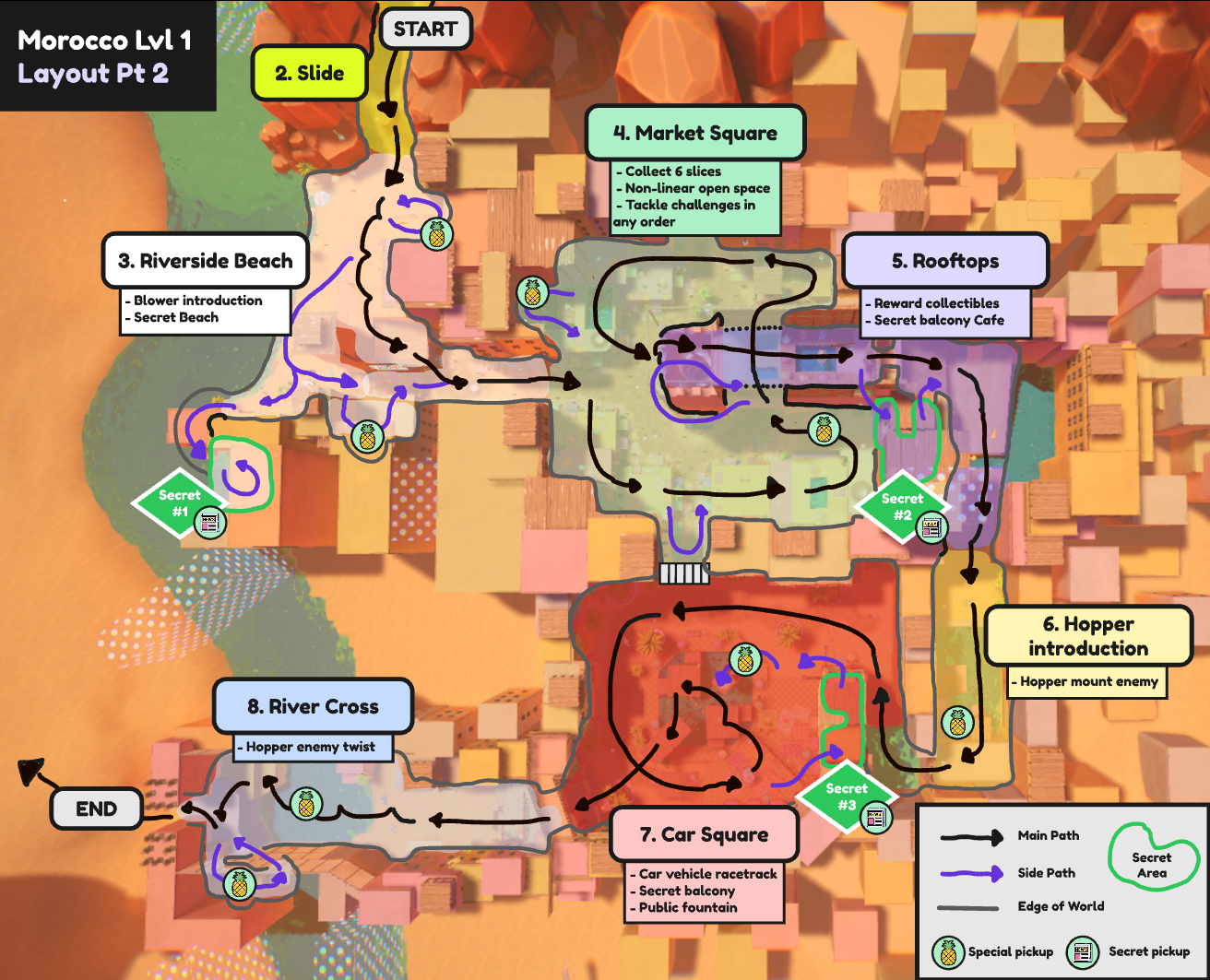
Market Square beats: from sketch to blockout

Level Structure and Identity
For concepting the level structure it was essential to create a plan for a visually and mechanically varied experience across the different challenge beats. This boiled down to defining the main characteristics of the elements that would make the level stand out in the game and figuring out the pacing for those elements. This included:
Featuring Sand Slides as a way to make going down a fun experience - this solves issues of climbing to unrealistic heights that would break immersion
Using pools as the primary hazard, selling the visual of holiday apartments and making platforming challenging
Planning out the main story beats of the level in collaboration with the design lead for a satisfying journey arc across it
Experimenting with different sequences of unique beats to achieve a satisfying pacing that keeps the player engaged
Flip through the slideshow below!


Clear Objective
To intrigue and motivate the player to move forward they need to be given a reason to do it. Playtests concluded that without a clear aim players are less motivated to complete challenges.
The end goal/reward of the specific section needs to be visually clear to the player, so they can use their problem solving skills to figure out a way to bridge the gap between them and that goal.
Rhythmic Movement
Looking at other 3D platformers’ design principles it was concluded that the rhythm and sequence of button presses on the gamepad creates the satisfying, melodic flow of the platforming sequence.
Building beats that incentivised the player to execute a fun, rhythmic sequence of moves proved essential for finding the fun.
4-Step Level Design
The Ki-sho-ten-ketsu approach of level structure was used to create individual beats:
introducing the challenge and the end goal to the player,
Letting them engage with the problem
Subverting their expectations with a new element (bouncing and swinging LD ingredients in the video to the left)
Rewarding them with a satisfying conclusion and pickups in the end.
Semi-Openness
Drawing conclusions from the design of popular 3D platformers a certain degree of non-linearity and player freedom to tackle challenges in any order proved to create a more free, playground-eque experience that playtesters found enjoyable.
The Level Design challenge was to create paths and sub-objectives that naturally blend into each other, creating a satisfying level flow.

Beat Design Principles
Moving from the macro to the micro level, after concepting and experimentation in the Gym Level these ended up being the leading principles and guidelines for designing individual platforming beats:
Unique Beat Story
Every beat needed to have a memorable “story” of what the player is doing in that challenge that defined and differentiated the specific beat. Examples of this included:
Scouring a bustling marketplace for 6 Pizza Slices to unlock a central door
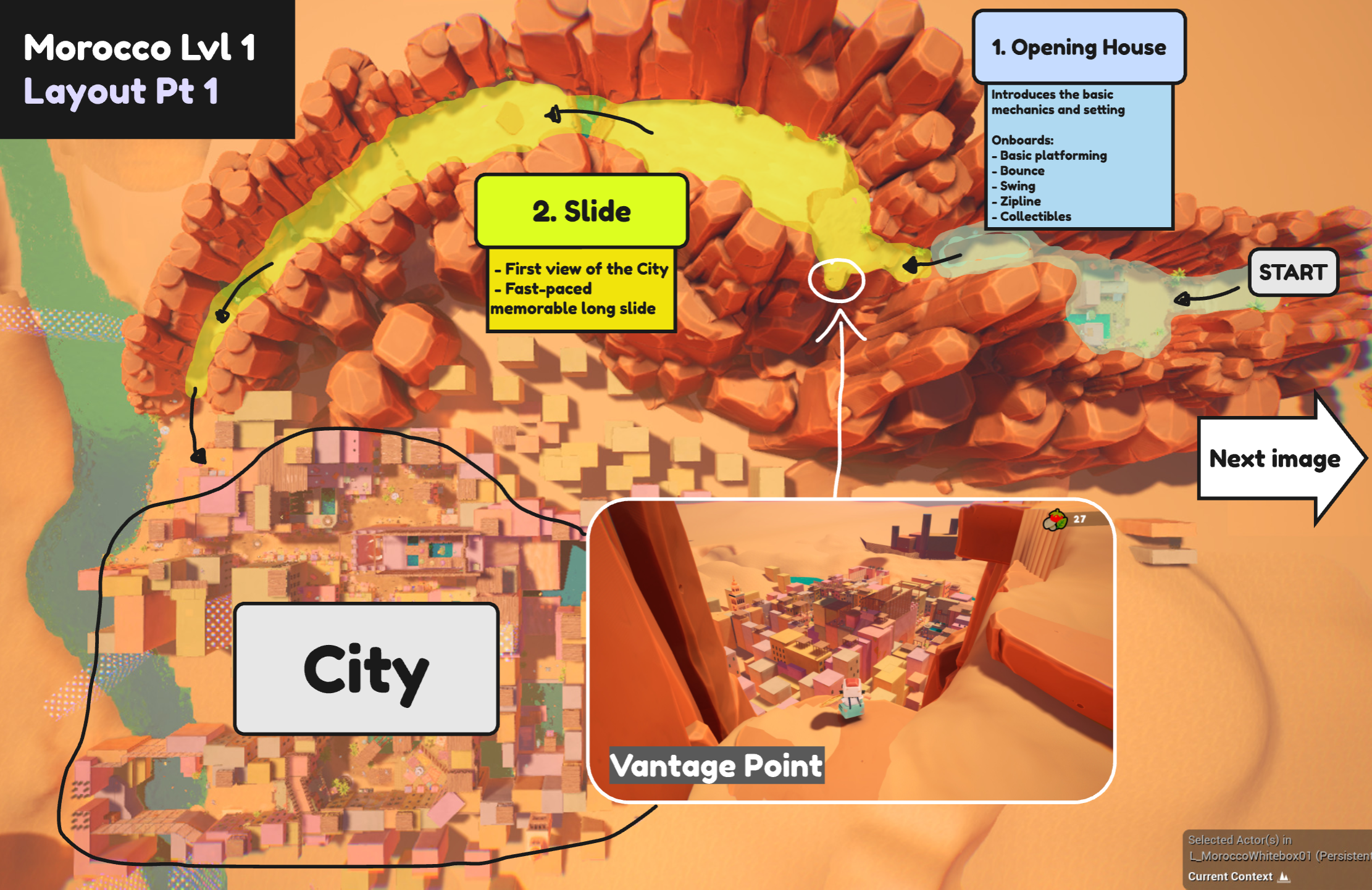
Sliding down a mountain to reach the city visible from a cliff
Jumping into a little tuk-tuk car to mow down enemies in a satisfying way

Sliding Section
The Sand Slide section was aimed to serve a number of purposes in the Morocco level:
Start the Morocco chapter in the game with a memorable moment
Set up a way to put the player on a vantage point, providing overview of the City, introducing the setting, atmosphere and main goal to reach the PIzzaCorp facility on the other side of the river.
Onboard sliding as the main mechanic to go downward in a fun way - also solving the design problem of jumping downward not being fun, but scaling vertically forever being unrealistic
Project reflection
After finishing a number of student projects with school-assigned teams this was my first experience of working in a team that was professionally formed as a part of an initiative. Production and working hours were more strict and structured, which was a good segway for me into my internship on Helldivers 2 in the 2nd semester.
Through this project I managed to gain experience and improve my skills in many level design-related areas, including pacing, level structure, platforming beat design and collaboration. It provided a varied and branching challenge that I found very valuable.